


INTRODUCTION
Nontuberculous mycobacteria (NTM) refers to all mycobacterial species, excluding the Mycobacterium tuberculosis (Mtb) complex and M. leprae (1). To date, more than 200 NTM species have been identified (2). These opportunistic pathogens are ubiquitous in the environment, commonly found in man-made sources such as showerheads and water pipes, as well as in natural reservoirs, including soil and surface water (3). Although NTM can cause infections of the skin, soft tissues, and lymph nodes (4, 5), most clinical cases present with pulmonary disease (6). Of particular clinical concern is the ability of many NTM strains to infect both immunocompromised and immunocompetent individuals (7, 8).
Globally, the incidence of NTM pulmonary disease (NTM-PD) is rising annually (9). In South Korea, although the burden of tuberculosis (TB) has steadily declined, the number of NTM-PD cases has surged. Analysis of mycobacterial culture results from a centralized laboratory that incorporated samples from 185 medical institutions revealed that the NTM isolation rate increased from 2.7% in 2014 to 4.8% in 2019. Conversely, the isolation rate of Mtb decreased from 6.2% to approximately 3.3% in the same period (10, 11). Given the profound impact of NTM-PD on patient quality of life, identifying effective therapeutic options has become a critical priority (12). This need is further exacerbated by the increasing prevalence of resistance to macrolide-class antibiotics, which represents a significant public health challenge (13). To develop novel and effective therapeutic strategies against NTM-PD, a comprehensive understanding of the dynamic crosstalk between the host immune system and NTM pathogenesis is required.
Accumulating evidence suggests that neutrophils play dual, often paradoxical, roles in NTM infections. As primary innate effectors, neutrophils exert antimicrobial functions by generating reactive oxygen and nitrogen species, expressing pro-inflammatory cytokines, and producing neutrophil extracellular traps (NETs) (14, 15, 16). Early studies have indicated that either genetic or functional impairment in neutrophils leads to rapid bacterial dissemination, establishing these cells as critical gatekeepers against the initial NTM spread (17, 18). However, exaggerated infiltration of neutrophils can trigger a transition from defense to destruction. This hyper-inflammatory state contributes to the characteristic pathology of NTM infections, including bronchiectasis and tissue necrosis. Although the precise mechanisms underlying neutrophil-associated pathologies in NTM are still being elucidated, recent studies have highlighted the role of the type I interferon (IFN) signaling in driving pathological inflammation and lung destruction during TB—whether a similar pathway operates in severe NTM-PD remains unknown. Regardless, finely modulating these complex host-pathogen interactions is likely to be critical, as the balance between protective immunity and destructive inflammation ultimately determines disease outcomes.
In this review, we discuss the paradoxical dual function of neutrophils in mediating innate defense versus immunopathology during NTM infection. We further examine the mechanism by which neutrophil-mediated damage is modulated and briefly discuss clinical neutrophil profiles in the context of NTM-PD.
OVERVIEW OF NTM INFECTION AND HOST RISK FACTORS
NTMs are traditionally categorized into four groups based on growth rates and pigment production according to the Runyon classification system (19). This system distinguishes between slow-growing mycobacteria (SGM), which require more than 7 days to form visible colonies, and rapidly growing mycobacteria (RGM), which mature within a week. SGM are further subdivided into Groups I, II, and III based on their photoreactivity and pigmentation. In contrast, the RGM belongs to Group IV, a classification defined primarily by growth kinetics rather than pigmentation. Globally, the most prevalent causative agent of NTM-PD is the M. avium complex (MAC). Belonging to SGM Runyon Group III, MAC accounts for approximately 70–80% of all pulmonary cases worldwide and primarily includes M. avium and M. intracellulare (20). In South Korea, although MAC remains dominant, the M. abscessus complex (RGM) is the second most common isolate (21). In particular, M. abscessus subsp. abscessus (Mabc) is resistant to most conventional antibiotics and presents a formidable challenge to clinical management (22). This escalating antibiotic resistance underscores the urgent need for novel therapeutic interventions targeting NTM, particularly highly resistant RGM species (23).
Because NTM are ubiquitous in the environment and human-to-human transmission is rare, host-specific factors are the primary determinants of infection (24, 25). Clinical susceptibility is driven by a complex interplay among immune status, age, sex, body habitus, and preexisting lung pathology (26, 27, 28). Although the precise molecular mechanisms of NTM colonization remain under investigation, structural abnormalities in the lungs are the most significant predispositions (29, 30). Bronchiectasis is the most potent risk factor; patients with bronchiectasis exhibit an approximately 21-fold higher risk of developing NTM-PD than healthy individuals (31). Other vulnerable populations include those with chronic obstructive pulmonary disease, pulmonary fibrosis, and cystic fibrosis (32). Systemic immunosuppression also profoundly promotes NTM pathogenesis 33, 34). Patients with HIV/AIDS or those receiving immunosuppressive therapies such as corticosteroids and tumor necrosis factor (TNF)-α inhibitors are at a significantly heightened risk (35). Demographic factors also play a critical role; both incidence and mortality increase markedly in individuals over 65 years of age (36). Furthermore, the nodular bronchiectatic phenotype of NTM-PD occurs at a disproportionate frequency in postmenopausal women, although the underlying mechanisms remain unclear. Nutritional status is another key indicator, as a low body mass index (BMI < 18.5 kg/m²) and reduced skeletal muscle mass are closely correlated with increased risk (37, 38). While general innate and adaptive immune responses to NTM have been extensively documented in earlier literature (39, 40, 41, 42), these mechanisms fall outside the central scope of this discussion. To maintain focus on the specialized role of myeloid cells in pathogenesis, the following sections specifically evaluate the paradoxical functions of neutrophils during NTM infection.
FUNCTIONS OF NEUTROPHILS IN THE CONTEXT OF NTM INFECTION
It remains largely unknown how neutrophils are recruited to lung tissues during NTM infection. During Mtb infection, pro-inflammatory cytokines and chemokines, including CXCL1, CXCL2, and CXCL5, are responsible for feed-forward recruitment, which causes excessive neutrophil infiltration into the lungs (43, (44, (45). In contrast, it remains largely unknown how neutrophils are recruited to lung tissues and which functions they perform in the context of NTM pulmonary infection. The CXC receptor 2 (CXCR2) chemokine receptor is required for neutrophil recruitment in intraperitoneal infection models, but not in aerosol infection with M. avium. However, there was no significant relationship between neutrophil recruitment (due to CXCR2 deficiency) and increased bacterial proliferation or systemic dissemination (17). These data suggest that host cells employ redundant or compensatory pathways to recruit neutrophils to control the early defense against individual types of NTM (17). Therefore, it is necessary to identify the molecules essential for neutrophil recruitment in certain contexts of NTM infection.>It remains largely unknown how neutrophils are recruited to lung tissues during NTM infection. During Mtb infection, pro-inflammatory cytokines and chemokines, including CXCL1, CXCL2, and CXCL5, are responsible for feed-forward recruitment, which causes excessive neutrophil infiltration into the lungs (43, (44, (45). In contrast, it remains largely unknown how neutrophils are recruited to lung tissues and which functions they perform in the context of NTM pulmonary infection. The CXC receptor 2 (CXCR2) chemokine receptor is required for neutrophil recruitment in intraperitoneal infection models, but not in aerosol infection with M. avium. However, there was no significant relationship between neutrophil recruitment (due to CXCR2 deficiency) and increased bacterial proliferation or systemic dissemination (17). These data suggest that host cells employ redundant or compensatory pathways to recruit neutrophils to control the early defense against individual types of NTM (17). Therefore, it is necessary to identify the molecules essential for neutrophil recruitment in certain contexts of NTM infection.
Emerging data suggest a dual function of neutrophils in NTM pathogenesis, acting as essential protectors in the early stages, while driving pathological outcomes in advanced diseases, such as NTM-associated bronchiectasis (18). In this section, we discuss 1) neutrophil recruitment, 2) protective neutrophil functions, 3) detrimental pathological functions of neutrophils (Fig. 1), and 4) NETs in the pathogenesis of NTM infections (Fig. 2).
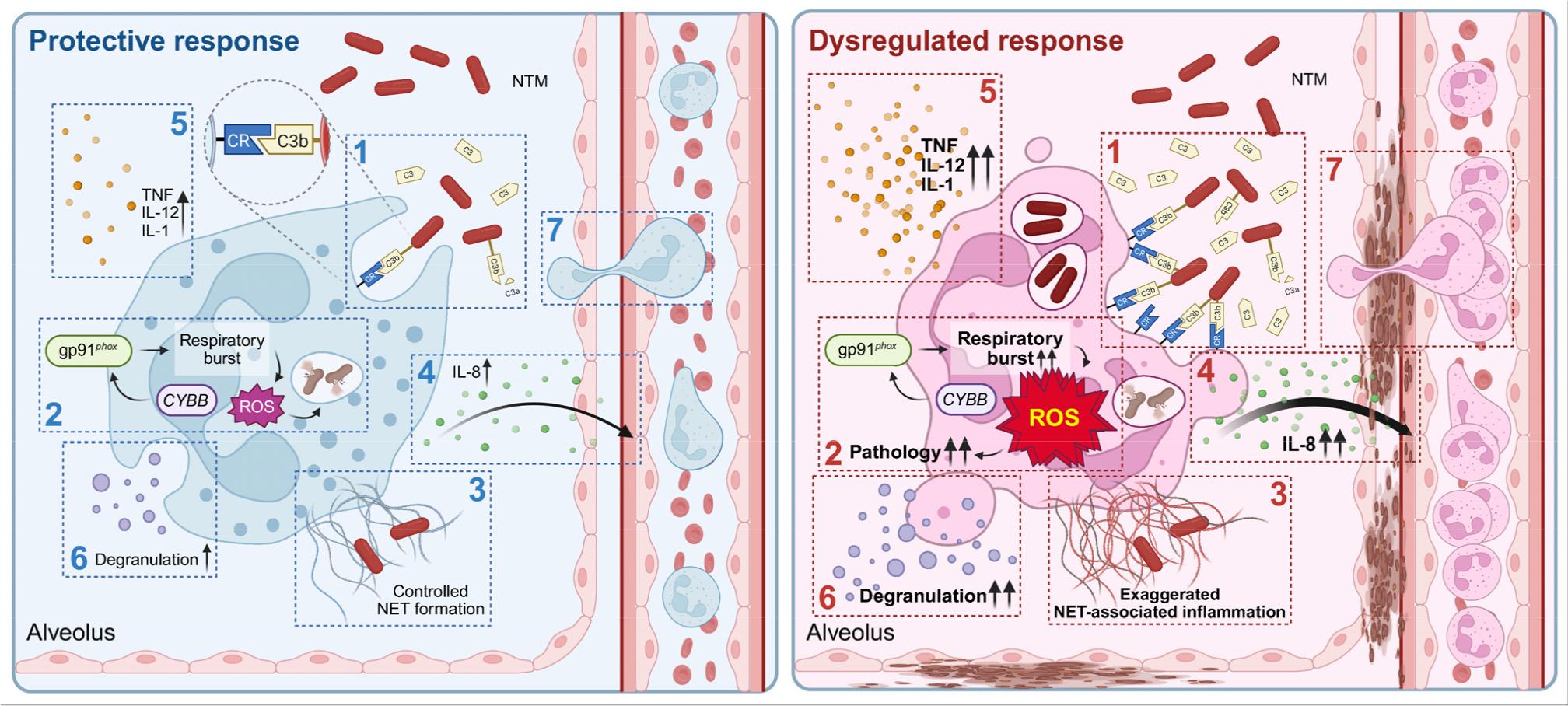
Fig. 1
Dual roles of neutrophils in nontuberculous mycobacterial pulmonary infection. Neutrophils play both protective and pathogenic roles within the alveolar microenvironment in response to NTM infection; (1) Neutrophils recognize and engulf complement-opsonized NTM, which promotes antimicrobial responses. However, excessive NTM uptake induces hyperactivation of neutrophils, resulting in tissue injury; (2) Phagocytosed bacteria activate CYBB/gp91phox-dependent respiratory burst and generation of ROS, contributing to intracellular bacterial killing but, when inordinate, promote pathology; (3) NET formation is tightly controlled during protective immunity, while it becomes overstated during dysregulated inflammation, amplifying NET-associated tissue damage; (4) Neutrophils produce IL-8 to enhance chemotactic signaling and upregulate additional neutrophil recruitment. Whereas excessive IL-8 production attracts undue neutrophils; (5) Neutrophils also release proinflammatory cytokines, including TNF, IL-12, and IL-1, which support host defense but, when overproduced, also drive inflammatory tissue damage; (6) Degranulation contributes to antimicrobial activity under normal conditions, whereas excessive degranulation aggravates alveolar tissue injury; (7) Neutrophil transmigration and accumulation at the infection site in alveolus help contain NTM locally, but persistent infiltration disrupts epithelial barriers and facilitates progressive lung pathology. CYBB, cytochrome b-245 beta chain; IL, interleukin; NET, neutrophil extracellular trap; NTM, nontuberculous mycobacteria; ROS, reactive oxygen species; TNF, tumor necrosis factor.
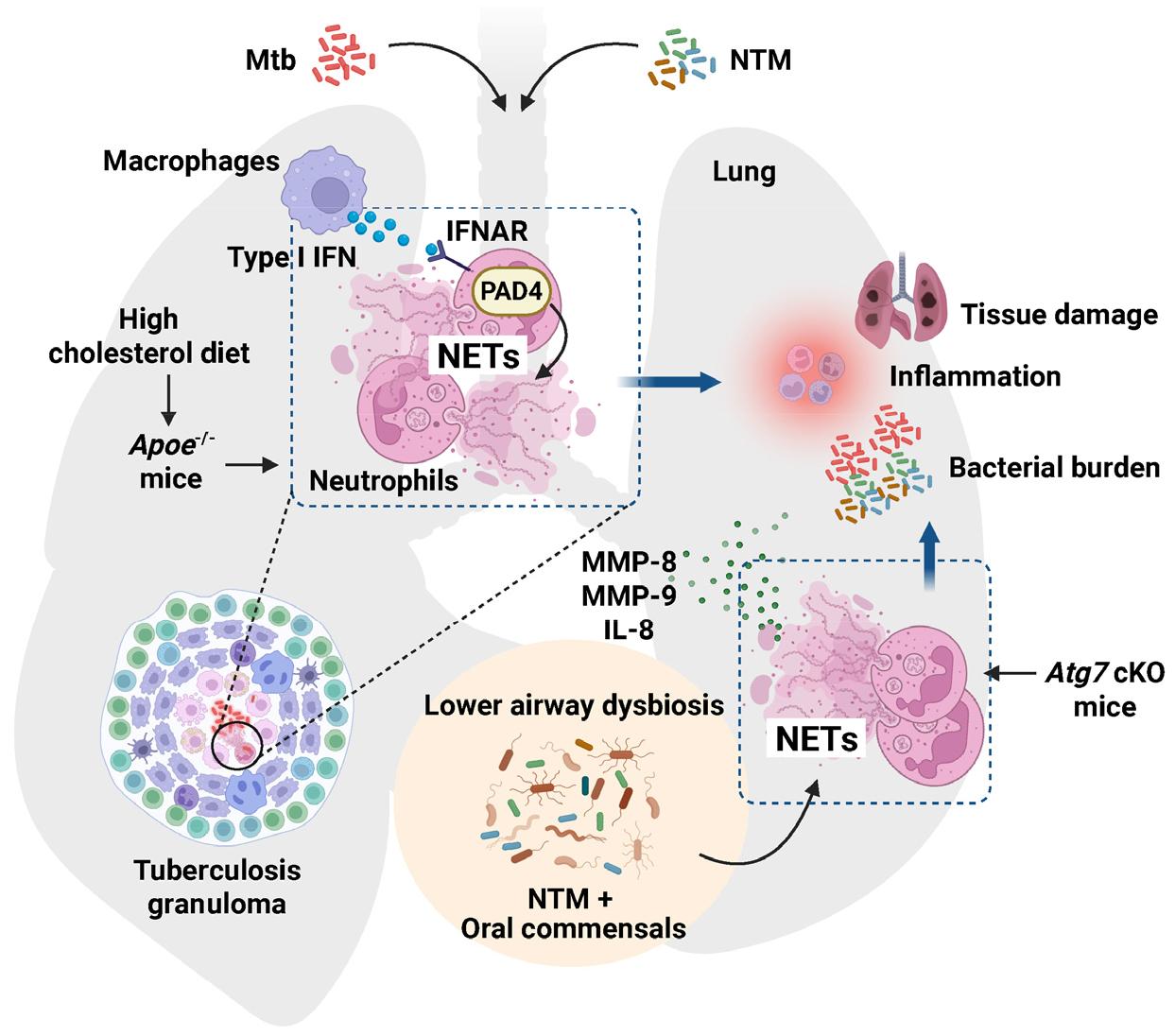
Fig. 2
NETs as drivers of immunopathology in mycobacterial pulmonary infections. During Mtb infection, PAD4-mediated histone citrullination and type I IFN signaling from neighboring macrophages drive NET release, and Apoe⁻/⁻ mice fed a high-cholesterol diet exhibit robust neutrophil influx and severe immunopathology. Similarly, pathogenic NTM induces PAD4-dependent NET formation, triggering MMP-8/9 and IL-8 release. Co-exposure to NTM and oral commensals further amplifies NET formation. Downregulation of ATG7 in in neutrophils/myeloid cells additionally exacerbates neutrophil-driven NET release. Collectively, excessive NETs drive tissue destruction, sustained inflammation, and increased bacterial burden in mycobacterial pulmonary infections. ATG7 cKO, autophagy-related gene 7 conditional knockout; IFN, interferon; NET, neutrophil extracellular trap; NTM, nontuberculous mycobacteria; PAD4, peptidylarginine deiminase 4.
Neutrophil recruitment during NTM infection
The mechanisms governing neutrophil recruitment to the lungs during NTM infection remain poorly characterized. In a murine model of NTM infection, CXCR2 was dispensable for neutrophil recruitment during aerosol M. avium infection, despite being required in intraperitoneal challenge, and its loss had no measurable effect on bacterial burden or dissemination (17). By contrast, a zebrafish model of M. marinum infection identified Cxcl18b, a chemokine induced in uninfected stromal cells surrounding granulomas, as a novel CXCR2 ligand capable of driving neutrophil-specific chemotaxis toward the infectious focus (46). Together, these findings suggest that the relevance of CXCR2 signaling to neutrophil recruitment may depend on the NTM species and route of infection, and that additional, as-yet-uncharacterized ligands may act redundantly with established chemokines to direct neutrophils to sites of NTM infection. Identifying which specific ligand-receptor pairs govern neutrophil trafficking across different NTM species and infection routes remains an important area for future investigation.
Protective functions of neutrophils during NTM infection
Early studies showed that neutrophils are persistently elevated for up to 3 months following infection with M. avium, but are not exposed to avirulent or heat-killed strains (47). Neutrophils are professional phagocytes that play critical roles as the first innate immune cells in the phagocytosis of opsonized and non-opsonized NTM bacteria (18). In addition to phagocytosis, neutrophils exert a protective host defense through the production of reactive oxygen species, degranulation, NET formation, and intracellular pathogen killing (48). Specifically, the respiratory burst of neutrophils plays a crucial role in the host defense against various bacteria, including NTM and Mtb. In patients with chronic granulomatous disease, a specific mutation (I15V) of the CYBB gene, which encodes gp91-phox, was identified as the key factor for IFN-γ-induced amplification of the respiratory burst. This mutation was also associated with clinical improvement following 2 weeks of a co-treatment regimen consisting of IFN-γ and anti-mycobacterial therapy (49).
Particularly, neutrophils can migrate most rapidly to the site of infection, providing immediate protection against acute threats, including NTM infections (50, 51). Thus far, it has been thought that an essential function of neutrophils is to conduct host-protective responses, particularly during the early stages of NTM infection. An earlier study demonstrated the critical role of neutrophils in host defense against NTM infection using beige (Chediak–Higashi syndrome) mice (52). Beige mice exhibit rapid systemic dissemination of M. avium from the gastrointestinal tract during the early stages of infection (52). There is a striking influx of neutrophils in the lungs of beige mice, which are associated with more than half of MAC organisms (53). The transfer of healthy neutrophils from wild type mice to beige mice significantly reduced the bacterial load in the liver, indicating the crucial function of healthy neutrophils in early defense against NTM infection (52). These findings suggest that the quality, but not quantity, of neutrophils is critical for the bactericidal response during NTM infection.
Toll-like receptor 2 deficiency leads to defective neutrophil function and impaired antimicrobial response to M. avium infection in the early stages (54). In addition, the depletion of neutrophils during early M. avium infection leads to increased bacterial growth in vivo. Neutrophils in the early phase of infection have a capability to produce proinflammatory cytokine, including TNF-α, interleukin (IL)-12, and IL-1, compared with control uninfected mice (55). Moreover, NTMs, including M. smegmatis or M. avium, trigger robust initial signal to secrete high levels of proinflammatory cytokines, such as TNF-α and IL-8, which is a principal chemokine for neutrophil recruitment. These actions ensure the immediate mobilization of immune cells and rapid clearance of mycobacteria compared with Mtb, which mainly produces IL-6 and delays the host’s inflammatory responses (56). These data indicate a crucial role for neutrophils in the host immune response to NTM, particularly during the initial phase of infection.
Pathological functions of neutrophils during NTM infection
Neutrophils exhibit enhanced phagocytic activity against opsonized M. smegmatis, a process that triggers gelatinase granule exocytosis. This excessive release of effector molecules often results in neutrophil-mediated tissue damage, particularly in soft tissue infections (57). The correlation between bacterial virulence and neutrophil dynamics was further evidenced in a study on nine M. intracellulare strains; higher virulence phenotypes and genotypes were found to induce more robust neutrophil infiltration, which paradoxically accelerated disease progression in mouse models (58). Furthermore, the efficacy of neutrophil-mediated clearance depends heavily on the host factors. For instance, complement C3 opsonization, driven primarily by alternative and classical pathways, is essential for the neutrophil-dependent killing of M. avium. However, this process is notably impaired in the plasma of patients with cystic fibrosis, explaining the heightened difficulty in managing NTM infections in this clinical context (59).
Significant morphological plasticity in Mabc also plays a pivotal role in modulating neutrophil-driven pathologies. In murine models, the smooth (Mabc-S) variant of Mabc can spontaneously convert to the rough (Mabc-R) variant, a transition directly associated with increased morbidity. The rough variant acts as a potent pro-inflammatory stimulus, triggering an excessive influx of neutrophils that leads to severe rather than protective pulmonary pathologies (60). Thus, the host-pathogen interaction mediated by neutrophils is further complicated by the type and morphology of the NTM. Future studies will clarify the mechanisms by which components of NTM pathogens actively modulate neutrophil recruitment, exploiting what should be a protective immune function for their own survival and pathogenesis.
Neutrophil-induced pathological responses are associated with genetic susceptibility of the host. A previous study using different strains of mice showed that the severity of pulmonary destruction during mycobacterial infection is dictated not by the virulence of the pathogen itself, but by the genetic susceptibility of the host. In genetically vulnerable hosts such as B6 mice, M. avium infection triggers the formation of necrotic granulomas and an excessive influx of neutrophils, thereby exacerbating tissue damage through uncontrolled inflammatory responses (61). These data suggest that host genetic predisposition is closely associated with neutrophil-induced lung injury and chronic inflammation during NTM infection.
NEUTROPHIL EXTRACELLULAR TRAPS: A CRITICAL DRIVER OF PATHOGENESIS IN NTM INFECTIONS
NETs are long, filamentous, web-like structures composed of extracellular DNA, histones, granule-derived enzymes, and antimicrobial proteins released by neutrophils. NETosis is triggered by various stimuli including fungi, bacteria, viruses, parasites, and sterile inflammation (62). The primary function of NETs is to trap and neutralize invading pathogens, thereby limiting their spread and allowing other immune cells to eliminate them (62, 63, 64). Accumulating evidence suggests that uncontrolled NETs formation is involved in the development of various diseases, such as autoimmune-related disorders and atherosclerosis (62). Additionally, NETs can activate inflammasomes, further enhancing disease progression and sustaining inflammatory responses in disease conditions (64).
Although there are few studies on the role of NETs in NTM infections, numerous findings suggest that NETs formation plays a detrimental role in the pathogenesis of Mtb infection. Mtb-induced vital NETosis leads to the formation of NETs, which function as specialized niches for Mtb replication and eventually facilitate its transmission. In this process, peptidylarginine deiminase 4 (PAD4), the enzyme for histone citrullination and chromatin decondensation, plays a critical role in the non-lytic release of DNA for NET formation. In addition, type I IFN signaling induced by neighboring macrophages triggers the formation of intracellular chromatin-containing vesicles that initiate NET release (65). Moreover, in Apoe-/- mice fed a high-cholesterol diet, Mtb infection leads to a robust influx of neutrophils into the lungs, thereby resulting in severe host immunopathology. Depletion of neutrophils, inhibition of type I IFN signaling, and blockade of PAD4 significantly improved the outcome of TB in these mice (66). Furthermore, in the absence of granulocyte- macrophage colony-stimulating factor signaling or genetically susceptible mice (C3HeB/FeJ mice), hosts become hypersensitive to type I IFN signaling, which is essential for triggering pathological NETosis, releasing excessive NETs, and contributing to disease severity and tissue damage in Mtb infection (67). Thus, in the context of Mtb infection, NETs are functional drivers of pathological inflammation and tissue destruction rather than protective immune responses.
Whether type I IFN-driven vesicular NET release, established primarily in Mtb infection, also operates during NTM infection remains untested and should be regarded as an open question. In contrast, PAD4-mediated NET formation has been directly examined in NTM: all MAC strains, including M. avium isolated from patients with lung infection, induced robust NET formation, whereas non-pathogenic mycobacteria (M. gordonae and M. smegmatis) induced only a slight, non- significant increase. PAD4 inhibitor reduces MAC-induced NET formation and alleviate the MAC-induced release of matrix metalloproteinases (MMP)-8 and MMP-9, as well as IL-8, by neutrophils (68). These findings suggest that NTM induce NET formation, enhancing proinflammatory cytokines and tissue-degrading enzymes such as MMP-8 and -9, thereby contributing to further inflammation and NTM progression in the lungs (68). In patients with NTM lung disease, distinct oral commensals, including Veillonella, Prevotella, Streptococcus, and the causative NTM are increased and associated with the excessive activation of neutrophils and NETs. Thus, combined oral commensals and mycobacteria contribute to the acceleration of sustained proinflammatory responses, Th17 responses, and exaggerated lung damage during infections (69).
We recently showed that the autophagy-related gene 7 (ATG7) level is downregulated in blood mononuclear cells and necrotic lesions at disease sites in NTM-infected patients. In mice lacking Atg7 in the innate immune cells, neutrophil infiltration, accompanied by NETs formation in the lungs, plays a critical role in bacterial growth by exacerbating inflammation and gasdermin E-associated cell death. Elevated pathological inflammation and combined cell death in these mice led to increased bacterial growth in the lung tissues. These data indicate that ATG7 in innate immune cells plays a role in orchestrating the host defense against NTM lung infections by alleviating neutrophil-driven pathological inflammation (70). More extensive studies are warranted to determine which NTM strains exploit NETs as a protective niche for replication to evade host immune responses and how NTM-induced NETs formation triggers lung parenchymal destruction and contributes to the pathogenesis of bronchiectasis and cavitary lesions during infection. To date, evidence for NET-mediated pathology in NTM infection remains limited to a small number of experimental and clinical observational studies (68, 69, 70). Given the established role of type I IFN signaling in driving pathologies in Mtb infection (67, 71, 72), future studies are needed to determine whether this mechanism is conserved in NTM infection and whether NTM-induced NETs function primarily as a protective host defense or instead contribute to tissue damage, as observed in TB. Addressing these questions will provide important insights into the pathogenic role of NETs in NTM-specific infection models.
INTERACTIONS OF NEUTROPHILS WITH OTHER IMMUNE CELLS TO DETERMINE INFECTION OUTCOMES
The interaction between neutrophils and macrophages is critical for both early clearance of viable Mtb and prevention of bacterial dissemination and immunological pathology in the established phase (51). An ex vivo analysis revealed that neutrophils and macrophages isolated from granulocyte colony-stimulating factor (G-CSF)-treated mice exhibited increased microbicidal capabilities against MAC. However, the optimal dose of G-CSF, which modulates granulopoiesis, is essential for therapeutic effects against MAC, because treatment with the highest dose of G-CSF did not decrease bacterial growth in vivo(73).
Notably, antimicrobial peptides and enzymes within neutrophil granules can be transferred to macrophages via efferocytosis. Macrophages that ingest neutrophil-derived materials, such as lactoferrin and myeloperoxidase, enhance anti-NTM activity, suggesting an important role for neutrophils in supplying and empowering macrophages to control NTM infection (47). These studies suggest that adjunctive therapy using G-CSF and the appropriate activation of neutrophils, as well as their interaction with macrophages, contribute to the development of a viable and strategic approach for treating chronic and refractory MAC infections. However, further studies should be conducted to translate in vitro and animal studies to humans.
Looking more closely at the NTM infection models revealed to date, it was found that in the M. marinum-infected mouse model, neutrophils are a major immune cell population at the site of infection along with lymphocytes and macrophages, and are involved in granuloma structure formation in the early stages of infection (74). ESX-1, a major virulence factor in Mtb and M. marinum, promotes neutrophil accumulation and immunopathology in granulomatous lesions (75). In particular, Ly6C+ MHC-II+ monocytes are the major cell type that express inducible nitric oxide synthase to promote host defense in NTM-infected tissues. An antagonistic interplay between monocytes and neutrophils restricts neutrophilic inflammation during mycobacterial infections (75). Therefore, cell-to-cell interactions between neutrophils and other immune cells may play a critical role in maintaining the balance between host protection and detrimental pathologies during NTM infections.
NEUTROPHIL PROFILES AND THE DISEASE SEVERITY IN CLINICAL NTM DISEASES
An earlier study of the gene profiles of 25 patients with NTM showed an association between immune response gene profiles, survival, and mortality (76). Patients with NTM-PD and higher survival rates exhibited robust genetic signatures associated with adaptive immunity and strong upregulation of pathways related to T-cell activation and B-cell function. In contrast, the risk of mortality was significantly higher in patients dominated by the innate immune signaling and systemic inflammatory pathways. These findings suggest that the high intensity of nonspecific inflammatory signals with excessive myeloid cell activity drives clinical deterioration during NTM infection. This indicates that a “precise and coordinated” immune response is a fundamental prerequisite for recovery and pathogen clearance.
In the context of neutrophil profiles, a recent study comparing histomorphological features in 27 biopsies from NTM infections and 27 biopsies from Mtb infection confirmed that the neutrophil count was significantly higher in NTM infections than in Mtb infections (77). In another study of a bronchiectasis cohort in Japan, the prevalence is 39.3%; however, NTM infection was not related to disease exacerbation. Notably, the non-NTM patient group exhibited higher levels of inflammatory markers and blood neutrophil counts, as well as frequent Pseudomonas aeruginosa colonization. These data suggest that NTM infection does not necessarily worsen the disease prognosis (78). These findings suggest that the clinical impact of NTM infection may vary depending on the underlying disease context, concomitant microbial colonization, and sample compartments across studies. Whereas the former study compared tissue neutrophil infiltration between NTM and Mtb infections (77), the latter evaluated circulating blood neutrophils in patients with or without NTM infection within a bronchiectasis cohort (78), highlighting that tissue and systemic neutrophil responses may not necessarily parallel each other.
In addition, several reports have demonstrated that NTM infections are associated with neutrophil count and pathways. A previous study using single-cell RNA sequencing of peripheral blood samples from six patients with NTM revealed an increased IFIT1+ neutrophil subcluster in the patient group compared to healthy controls (79). Additionally, gene expression analysis of surgical specimens from patients with MAC-infected lung disease revealed activation of neutrophil migration pathways in airway epithelial cells (80). Moreover, a retrospective analysis of 63 patients with pulmonary NTM disease demonstrated an anti-neutrophil cytoplasmic antibody (ANCA) positivity rate of 11.1% (n = 7) with a subsequent diagnosis of ANCA-associated vasculitis (81). However, the roles and mechanisms by which ANCA contributes to immunity and disease pathogenesis are not fully understood. Notably, a recent report revealed that a high neutrophil-to-lymphocyte ratio in patients with NTM infection is highly associated with morbidity in NTM disease patients (82). Future studies are warranted to elucidate the clinical impact of neutrophil recruitment to disease sites, particularly across distinct NTM species and at various clinical stages. Such investigations are critical to determine whether neutrophil infiltration serves as a biomarker for disease progression or a viable target for therapeutic interventions in NTM-PD.
Neutrophils play a critical role in the host immune response in patients with hematologic malignancies. Among these patients, MAC was the most prevalent isolate (38%), followed by Mabc (21%), indicating the significance of opportunistic mycobacterial infections in immunocompromised hosts. Notably, patients with neutropenia have a significantly higher risk of progression to disseminated disease. Moreover, the 30-day mortality rate of patients with NTM was alarmingly high at 15%, markedly exceeding the 2% mortality rate observed in patients with TB. This highlights the high virulence and management difficulties of NTM in the context of underlying haematological cancers. Additionally, an inadequate initial neutrophil count facilitates the systemic spread of NTM beyond the pulmonary system (83) (Table 1).
Table 1.
Neutrophil profiles and the disease severity in clinical NTM disease
|
Clinical pathogens/ disease | Study population |
Immune cells examined | Study outcome | Ref |
|---|---|---|---|---|
|
NTM vs. Mtb |
27 biopsies of NTM 27 biopsies of Mtb | Lymphocytes, plasma cells, neutrophils, macrophages, MGCs |
Neutrophil infiltration: NTM > Mtb, CD68, CD206: Mtb and NTM granulomas (both↑), CD163: elevated in non-granulomatous regions Histiocytes: Epithelioid (Mtb) vs. Mixed foamy/epithelioid (NTM) | (77) |
|
BE with NTM infection | 1044 BE patients; NTM prevalence 39.3%; overall severe exacerbation rate 22.3% (not associated with NTM status) | Blood neutrophils |
↓ Neutrophilic inflammation in NTM infection ↓ Neutrophils, ↓ CRP, and P. aeruginosa colonization No OS difference in NTM vs non-NTM | (78) |
|
MAB and MAC-PD patients |
3 MAB-PD, 3 MAC-PD, 27,898 peripheral bloods immune cells | T-cells, MPs, and Neutrophil subclusters |
Expanded IFIT1+ neutrophil subcluster ↓ Naïve T cells, ↑ Effector T cells ↑ CXCL8–CXCR1/2 signaling between IFIT1+ neutrophils and NK/NKT/Mo1/Mo2 cells in NTM-PD patients | (79) |
| MAC |
7 MAC-LD vs. 8 Lung cancer patients | AECs |
↑ IL-17, neutrophil migration, and complement cascades ↑ CCL20, MMP9, C3, and SLC26A4 expression ↑MMP9 linked to cavitary lesions, ↑SLC26A4 to bronchiectasis severity | (80) |
| NTM-PD |
63-NTM patients underwent MPO or PR3- ANCA testing |
ANCA positivity (11.1%) was associated with AAV, MPA, and glomerulonephritis | (81) | |
| NTM-PD |
147 newly diagnosed NTM disease |
WBCs, neutrophils, CD4/CD8 ratio |
MAC (55.8%) and M. abscessus (21.2%) were predominant Aspergillus and P. aeruginosa co-infection more common in pulmonary vs. disseminated NTM disease NLR and NMLR predicted NTM mortality | (82) |
|
Haematological malignancies with NTM infection |
2846 Haematological malignancy patients including 34 NTM | Neutrophils | MAC (38%) was predominant, followed by M. abscessus (21%), M. fortuitum (18%), and M. kansasii (18%); NTM Dissemination: predisposed by neutropenia | (83) |
AECs, airway epithelial cells; AAV, ANCA-associated vasculitis; ANCA, anti-neutrophil cytoplasmic antibody; BE, bronchiectasis; CRP, c-reactive protein; IFIT1, interferon-induced protein with tetratricopeptide repeats 1; MAB-PD, Mycobacterium abscessus pulmonary disease; MAC-LD, M. avium complex lung disease; MAC-PD, M. avium complex pulmonary disease; Mtb, Mycobacterium tuberculosis; MGCs, multinucleated giant cells; Mo1, mononuclear phagocytes subcluster 1; Mo2, mononuclear phagocytes subcluster 2; MPs, mononuclear phagocytes; MPA, microscopic polyangiitis; MPO, myeloperoxidase; M. abscessus, Mycobacterium abscessus; M. fortuitum; Mycobacterium fortuitum; M. kansasii, Mycobacterium kansasii; NK, natural killer; NKT, natural killer T; NLR, neutrophil-to-lymphocyte-ratio; NMLR, neutrophil-to-monocyte-plus-lymphocyte-ratio; NTM, nontuberculosis mycobacteria; NTM-PD, non-tuberculous mycobacterial pulmonary disease; OS, overall survival; PR3, proteinase 3; WBCs, white blood cells.
THERAPEUTIC IMPLICATIONS AND LIMITATIONS FOR CLINICAL TRANSLATION
Accumulating studies have highlighted neutrophils as potential therapeutic targets in NTM-PD. Previous experimental studies showed that PAD4 inhibition reduced MAC-induced NET formation accompanied with the downregulated production of MMP-8, MMP-9, and IL-8 (68), suggesting that limiting exaggerated NETosis ameliorates neutrophil-driven tissue damage. In other aspect, upregulation of innate immune defense has also shown promising results. Administration of G-CSF enhanced the antimicrobial activity of neutrophils and macrophages against MAC in animal models, although its efficacy was dose-dependent, with the highest dose failing to further reduce the bacterial burden (73). In addition, modulating type I IFN signaling has improved disease outcomes in several Mtb infection models (66, 67), raising the possibility that similar approaches may contribute to the treatment against NTM-PD. However, it remains to be determined whether these strategies are beneficial in NTM-PD. In addition, adjunctive IFN-γ therapy combined with antimycobacterial treatment has shown clinical benefit in patients with chronic granulomatous disease (49), supporting the concept that host-directed immunomodulation may complement conventional antimicrobial therapy in the management of NTM-PD.
Despite these efforts, several challenges remain before neutrophil-targeted strategies can be translated into clinical practice. The timing, dosage, and duration of therapeutic intervention should be carefully optimized. In addition, it remains to be determined whether PAD4- and type I IFN-targeted pathways function similarly across different NTM species. Given the heterogeneity among NTM species and strains in virulence, immune evasion, and host inflammatory responses, it is unlikely that a single neutrophil-directed strategy will be universally effective. Future studies should define species-specific neutrophil responses and determine how neutrophils function vary according to disease stage and host immune status before these strategies can be generalized to clinical practice. Moreover, biomarkers that distinguish protective from pathological neutrophil functions need to be identified to facilitate personalized neutrophil-directed host therapies for patients with NTM-PD.
CONCLUSION
Accumulating evidence suggests that the maintenance of immune homeostasis enhances host protection, while preventing excessive immunopathology during NTM infections. Neutrophils play a paradoxical double-edged role in the context of NTM infections: essential defense and immunopathology. Neutrophils constitute an indispensable primary defense line during the early stages of infection. When properly activated, they function as potent effectors capable of a direct microbicidal action. However, excessive or dysregulated neutrophil infiltration, driven by host genetic susceptibility or virulent rough variants, can lead to irreversible tissue damage such as necrotic granulomas and exacerbation of chronic airway diseases such as bronchiectasis.
Therefore, the management of NTM diseases hinges on the precise modulation of the “neutrophil double-edged sword.” The therapeutic objective must shift from simple pathogen eradication to a more sophisticated approach upon the fine-tuning of neutrophil functions. Achieving this balance remains the central challenge in the clinical treatment of mycobacterial infections.