
Original Article

Sapkota A. Pseudomonas aeruginosa: Overview, Pathogenesis & Treatment. Available at https://microbenotes.com/pseudomonas-aeruginosa/ [accessed on 17 February 2025].
Tchinda CF, Demgne OMF, Mbaveng AT, Beng VP, Kuete V. Antibacterial potential and modes of action of botanicals from Momordica foetida (Cucurbitaceae) against multidrug-resistant bacteria expressing active efflux pumps. Investigat Med Chem Pharm. 2023;6(2):78.
10.31183/imcp.2023.00078HiMedia. Xylose Lysine Deoxycholate Agar (XLD Agar). Available at https://www.himedialabs.com/us/m031-xylose-lysine-deoxycholate-agar-xld-agar.html [accessed on 2 February 2025].
Okafor C, Ogbodo S. Quantitative and Qualitative Analysis of the Ethanolic Extract of Watermelon Peels. Int J Develop Res. 2015;5(6):4686-4688.
Aryal S. Xylose lysine deoxycholate (XLD) Agar- Principle, uses, composition, preparation and colony characteristics. Available at https://microbiologyinfo.com/xylose-lysine-deoxycholate-xld-agar-principle-uses-composition-preparation-and-colony-characteristics/ [accessed on 20 February 2025].
Onning G, Juillerat MA, Fay L, Asp N. Degradation of Oat Saponins during Heat Processing - Effect of pH, Stainless Steel, and Irone at Different Temperatures. J Agric Food Chem. 2024;42(11):2578-2582.
10.1021/jf00047a039Microbiology Writing Guide: Presenting Data. (2017, December 8). Writing Intensive Curriculum Program. Available at https://wic.oregonstate.edu/microbiology-writing-guide-presenting-data [accessed on 31 March 2025].
- Publisher :The Korean Society for Microbiology and The Korean Society of Virology
- Publisher(Ko) :대한미생물학회‧대한바이러스학회
- Journal Title :JOURNAL OF BACTERIOLOGY AND VIROLOGY
- Volume : 56
- No :1
- Pages :1-12
- Received Date : 2025-05-02
- Revised Date : 2025-09-01
- Accepted Date : 2025-12-02
- DOI :https://doi.org/10.4167/jbv.2026.56.1.001
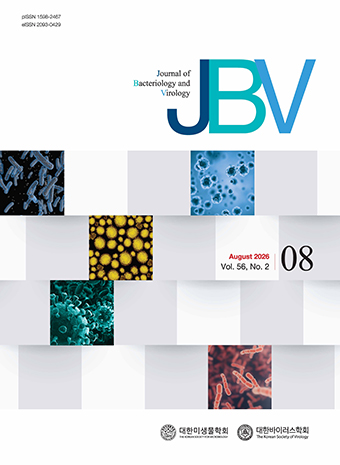 JOURNAL OF BACTERIOLOGY AND VIROLOGY